STROKE CARE
For
55-year-old Robert “Gene”
Earp, April 13, 2011, started
much like any other day. Little
did he know that date marked the
starting point of his most dicult
journey, which is probably best
described simply as remarkable.
Remarkable, in fact, is an
appropriate adjective to describe
Gene Earp in general. Some of
the other descriptors that apply
include independent, determined and
motivated.
Knowing what he knows now,
Earp probably also wishes he could
have been labeled compliant on that
spring day. But compliant he was not.
Earp, who moved to Murrells
Inlet from Winston-Salem, N.C., just
before his 50th birthday, knew he had
high blood pressure. He was being
treated for it and was on medication
to help keep it under control. But
for a variety of reasons, he was not
taking the medication as prescribed.
“I didn’t feel bad, and I thought
I would be all right,” he said,
expressing the sentiments of many
patients who opt not to follow the
medication regimen designed to help
control blood pressure.
Premonitions
e
rst indication that he was not all
right came early on April 13, as he was
showering and preparing for the day.
“I just didn’t feel right,” he says. “I
didn’t really know what was wrong,
but something was.”
Earp’s adult son, Josh, who lives
with his parents, noticed his father’s
speech was slurred. A¡er a call to 911
and an ambulance trip to Waccamaw
Community Hospital, the diagnosis
was grim. Earp had experienced a
major stroke, which le¡ him unable
to speak or move.
Earp has no memory of the next
few days spent at Medical University
of South Carolina before returning
to Murrells Inlet, where he was
admitted to Georgetown Hospital
System’s Waccamaw Rehabilitation
Center. He spent the next three
weeks there.
“When it was
nally time to go home,
I was really excited,” he says. “All I
could think about was going home.”
Little did he realize some of the
most dicult and demanding parts of
his recuperation were just about to
begin.
Since May 9, Earp has been
an outpatient at
Georgetown Hospital
System’s NextStep
Neurological
Rehabilitation Center,
where he’s received
speech, occupational and
physical rehabilitation
therapy several times a
week in sessions that last
as long as 2½ hours a
day. He has “graduated”
from speech therapy but
continues occupational
and physical therapy—
and sees progress every
day.
e NextStep
Neurological
Rehabilitation Center,
located in Murrells Inlet,
is the only dedicated
clinic of its kind in the
area and is one of the
services soon to be relocated into
Waccamaw Medical Park – West,
a new 90,000-square-foot medical
oce building under construction
on the campus of Waccamaw
Community Hospital.
e center oers a specialized
interdisciplinary approach to
rehabilitation for stroke patients like
Earp as well as patients with balance,
dizziness and other neurological
disorders, such as traumatic brain
injury, Parkinson’s disease, multiple
sclerosis, vertigo and memory
disorders.
Where patients come rst
e facility, which opened in 2007,
oers services similar to traditional
physical therapy. e dierence is
that for rehab, patients use their
bodies instead of equipment to
strengthen one speci
c, targeted body
part, such as the knee, hip or back.
When asked what surprises he
experienced in the rehabilitation
process, Earp is quick to say: “I
couldn’t believe how hard they [the
therapists] were on me. You
nd out
fast that you don’t say, ‘I can’t!’”
Earp is equally quick to praise
the treatment he’s received and
the care and compassion of the
therapy team members, who he said
oered emotional support as well as
directing his therapy: “ ey were so
caring. And they didn’t let me quit.”
A good attitude
So what leads to good outcomes for
patients with health problems like
these?
Joy Clark, MS, CCC-SLP, the
speech language pathologist who
treated Earp, names motivation,
a positive attitude, strong family
support and a desire to be
independent as the crucial attributes.
Gene Earp had all of that—and
more, Clark says: “He is very
determined. He set goals for himself
and was going to reach them.” Earp
praised his entire family, including
his wife, Patti, for their tremendous
support.
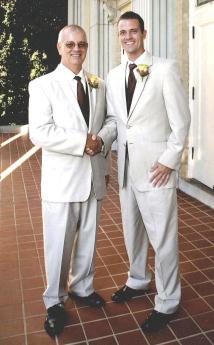
Earp’s eldest son, Brandon, and
his
ancée, Kate, had planned their
wedding for Oct. 1. And the man
who could not talk or move in April
set his sights on a goal of walking and
standing by his son as the best man at
his wedding.
“I did it!” Earp says, beaming. “I
wore a tux and shoes with slick soles.
But I did it!”
It was a proud and poignant
moment for Earp and his family.
And it was an achievement he
really couldn’t have imagined a
few months before.
www.georgetownhospitalsystem.org
3
Earp’s adult son, Josh, who lives
Since May 9, Earp has been
www.georgetownhospitalsystem.org
www.georgetownhospitalsystem.org
3
Robert “Gene” Earp standing with son Brandon
at his wedding
‘I did it!’ Earp says, beaming. ‘I wore a tux
and shoes with slick soles. But I did it!’
A father’s
journey
from stroke