www.georgetownhospitalsystem.org
7
For more information about the PC program, contact the PC team
at palliativecare@georgetownhospitalsystem.org.
Most
of us have no diculty in recalling a
particularly moving human experience. It’s the kind
of experience that aects you deeply and lives in
your memory forever. And it’s the kind of experience
almost everyone who has worked in health care
has encountered—not o¡en, but at some point.
But for the physicians, nurses and other members
of the multidisciplinary team who provide one
particular kind of care for Georgetown Hospital
System patients, these moments are the norm rather
than the exception.
ese kinds of experiences are at the core of
palliative care (PC), a type of care available at
Georgetown Memorial Hospital and Waccamaw
Community Hospital, which oers a holistic approach
to the relief of physical, emotional or spiritual
suering.
When the load becomes too heavy
Imagine a high school senior facing the challenges
of assuming responsibility for graduating from high
school and looking a¡er several younger siblings—all
while caring for her mother, who has an incurable,
end-stage disease.
e worry and sadness of knowing one’s mother’s
death was near would be struggle enough for
anyone—of any age. But try to envision the demands
faced by this student burdened with ensuring the
younger children have food and clothing, arrive at
school each day prepared with their homework done,
and get to bed each night—along with acting as a
caregiver and making next-of-kin decisions for her
dying mother.
is is where Amanda Vuppala, MD, and the
PC team at Georgetown Hospital System (GHS)
intervene. As dicult as it may seem, in cases like
this, much can be done to make sure the needs of
the patient and family are met. Whether it is helping
family members understand options such as creating
an advance directive, arranging counseling, or
suggesting ways to help alleviate the patient’s pain
through hospice or other types of available care, the
PC team works as a group, with each member focused
on speci
c needs.
“We try to address all of the needs,” Dr. Vuppala
explains. “Not all suering is physical. Palliative Care
recognizes the multidimensional nature of suering.
Our goal is to aid in the alleviation of symptoms
regardless of their cause.”
Dedicated specialists
At Georgetown Memorial Hospital, where the PC
program was piloted in 2009, and at Waccamaw
Community Hospital, where the program is now
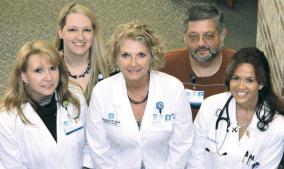
also oered, the team consists of a physician medical
director, nurse, social worker, chaplain and program
director. While the team addresses a wide variety of
needs, including emotional and spiritual support,
pain and symptom management, decision making,
establishing care goals, and helping to choose a
care setting, almost all of the eort revolves around
education.
“A lot of my role is education,” Dr. Vuppala says.
“In fact, education is the underlying theme of all of
our roles. We work hard to make sure patients and
families understand the disease process.”
Because PC is appropriate for both newly
diagnosed and end-stage patients who have
progressive, chronic illness, such as cardiac disease,
COPD, cancer, Alzheimer’s and renal disease, some
patients may have many years to live.
“ ey need to understand where they are in the
process,” says Carlette Stewart, RN, BSN, MSN,
director of palliative care. “If they have had the
disease for many years, they may not realize the
disease now has progressed, which may mean a
dierent outcome for them, with dierent sets of
considerations, expectations, challenges and needs.”
“One of the biggest misconceptions is that palliative
care is hospice,” Stewart says. “Hospice is end-of-life
care, and palliative care begins before the end of life
to help improve the quality of life while managing a
disease.”
Hospital patients can request PC services, but most
o¡en, patients are identi
ed by a family member or
caregiver during their evaluation in the hospital or by
a nurse on admission. If the patient’s physician agrees
that PC may be helpful and orders a consult, the PC
team visits the patient to
nd out what PC services
will help the patient’s and his or her family’s quality of
life during the disease process.
The need is great
Georgetown Hospital System’s PC program has grown
much faster than expected when it was initially
implemented. To date, nearly 1,000 patients and
families have been assisted by the GHS PC team.
So, what is next for the program?
“ at’s a really good question,” Stewart says. “We
don’t know for sure, but the needs and the program
are changing as we speak.”
What the team does know for now is that the
program helps to ensure that patients are getting
the right kind of care at the right time in their
disease process.
The PC program, which is provided to
patients and families at no charge except for physician
consultation, receives nancial support to help o set costs
of the program through donations made to the Georgetown
Hospital System Foundation. To help, call
.